
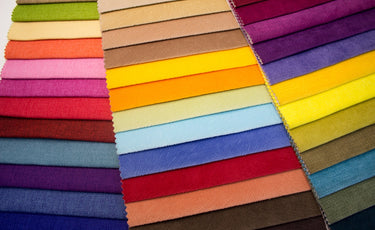
Textile, an industry necessary to dress, coat, decorate, embellish humans like homes.
It is certainly an important activity to develop, but it is also one of the most polluting on earth. My name is Mathieu Marchadier and I am currently doing a Masters in Economics and Management of the Environment and Sustainable Development. At Biom Paris, I am a sustainable development project manager, so I take care of supporting the company in its projects and carrying the colors of the environment and sustainable development high to integrate them into decisions.
Today, I'm going to talk to you about the beginning of my adventure at Biom Paris and the link that immediately took place with the textile as for the towels that we offer.
Our company Biom Paris is based on strong values. We seek every day to be useful by offering objects in tune with our times. Humanity faces great challenges to the health of our planet and we are working to provide solutions to some of these challenges. This is part of our DNA. The new object that we are going to create must therefore be consistent with our values and our missions.
So will you tell me, why is this industry so polluting and how can we fix it?
On the side of producers as consumers, the change does not take place in a snap of the finger, although it would be beneficial to our dear land. The first thing we can do, already as a consumer, is to inform ourselves to better understand how the industrial structure of textiles works, from the cultivation of cotton and other materials to our wardrobe. In reality, there are a lot of players in the value creation chain (about 6 without counting transport logistics). This therefore implies very difficult traceability and an abundance of transport to transport products from one country to another. Similarly, if the traceability of a T-shirt is almost 100% impossible, it is just as much about the veracity of many certifications and labels. Have you ever heard of "Greenwashing"? Well, I must say that since I started these studies, I have never become so aware of the ton of dust put under the rug by brands and manufacturers. The importance of getting information takes on all of this meaning here, if this act is of course accompanied by a questioning of one's way of consuming in order to tend towards consumption that respects the environment and social rights.
And on the side of industrialists and companies?
The process of awareness and questioning is somewhat different, because here we are not looking to spend to improve our comfort but to generate turnover. Yes, sustainable development does contain the word “development” and this intrinsically means “turnover”. The companies involved in this fight against unreasonable production could not work if they did not create economic added value. It's simply that this added value has been designed so that it respects ecosystems, biodiversity, to grow like a normal company, but serving the interests of humans and nature essential to all.
There are therefore several tools and ideas allowing a company to produce while taking into account all the environmental value possibly impacted during the creation of value. The first that comes to mind since it is the heart of Biom Paris is eco -design . Attention, it is not a question of saying that the product is made to last in infinity and that at worst it is recycled to say that it is eco-designed. This tool goes much further, taking into account through a Life Cycle Analysis (LCA) all the phases that a product goes through and how each phase can be improved. Besides, our BBB has been eco-designed!
To give you a small example, do you know for a plastic bottle of soda which is the most polluting part of life? The petrochemical manufacture of plastic? No. Its treatment as waste? Neither. It is during its consumption that it is the most polluting, because the energy expenditure in electricity to keep the bottle of soda cold is more impactful in terms of carbon footprint than its creation, its routing or its end of life. There you go, LCA makes it possible in particular to see this kind of element and to think about how to improve an already existing product, or even simply stop producing it.
Well, and to come back to textiles, where are we and what are we doing?
I won't dwell on the production aspect, unless you want another more detailed article on this whole phase, which is as interesting as it is polluting and degrading for many humans. The focus will be made from the eyes of Biom Paris , a company that is part of a sustainable development policy.
You probably know what an industry and a symbiosis are. What if I told you about industrial symbiosis?
Ah, there it may seem a little vague and even absurd to you when we put together "industry" which refers to pollution and black smoke and "symbiosis" where we can imagine a microcosm of fauna and flora in perfect harmony. Well once again, we take what is best in nature, how it works and we do some mimicry. The idea here is to spoil nothing, everything serves someone else and feeds them, so that "nothing is lost, nothing is created, everything is transformed" at the height of the concept as Antoine Lavoisier says, from whom I stole this quote to divert it somewhat from its initial subject. I popularize the concept but you may suspect that it is much more complex than a simple quote to look pretty in an article.
At Biom Paris, I therefore started looking for textile companies (particularly manufacturers) who were looking to part with their fabric scraps, which for them was originally waste. Why recover waste? Very simply because these are in good condition, are well made, and because it avoids spending energy again and again to cultivate the cotton, to transport it to all the factories and countries through which it must pass to become a finished piece. Did you know that a simple pair of jeans represents 4000 liters of water and travels an average of 9000km before arriving on our legs? The textile industry produces 1.2 billion tonnes of greenhouse gases each year. So, if on our scale, we can create added value from what already exists and considerably reduce our carbon footprint, let's do it.
Among the feedback received, I was pleasantly surprised to find that most already valued their own offcuts. Despite everything, it only represents, as we know, a minority of this entire branch worldwide. Let's stay focused on the positive, a pinch of companies I've contacted actually resell their scraps, coupons, or craft selvages like Nelen&Delbeke who are also super responsive and friendly. From there, it's my favorite part because I was able to discover more precisely the world of textiles from the inside, learn a few words of jargon, exchange and discover new companies, new concepts like Uptrade which focuses its activity on the purchase of offcuts and coupons, sorting and resale of these.
We should also receive our first purchases of scraps and coupons from two companies next week! We have plenty of ideas to enhance them and give them a better life than that of waste, such as towels , t shirts in linen and tote bags that we offer.
This is how we can remedy the pollution resulting from an industry as important as the textile industry.
